


Get production-ready code in Cursor and Claude with Bito’s AI Architect

The context layer your coding agent is missing 

Bito vs CodeRabbit

Code reviews are make-or-break moments in software development. Miss a critical bug, and it could cost your team hours of debugging in production. Catch it early, and you’ve just saved your project from a potential disaster. 

Bito and CodeRabbit are two AI code review tools revolutionizing how developers approach code reviews. Both tools promise to slash review times while catching more issues than human reviewers alone, but they offer distinct capabilities that set them apart. 

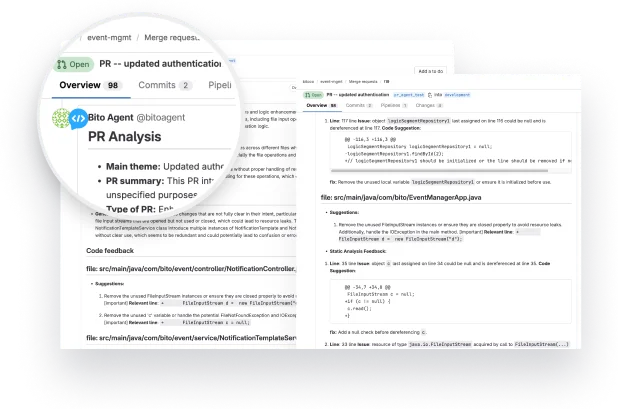
Bito built its AI Code Reviews on top of AI Architect, the context layer for autonomous development. AI Architect builds a knowledge graph from your code, your Jira and Linear tickets, your Confluence docs, your commit history, and your observability data. Every pull request reviewed by Bito carries that complete system understanding into the analysis, which gives Bito cross repo impact awareness, dependency tracing, and blast radius detection that diff only tools miss. Bito also extends AI Architect across design and scoping inside Jira and Linear, and into grounded coding inside Cursor, Claude Code, Codex, and Windsurf via MCP. 

CodeRabbit operates as an AI pull request reviewer, with recent expansions into a planning product and a Slack based agent. Its strength sits in the depth of feedback on the diff itself, with 40 plus linters and SAST scanners feeding the review pipeline, and codebase awareness from its Codegraph layer. 

For engineering teams evaluating CodeRabbit alongside Bito, this page lays out the head to head differences across review quality, platform scope, integrations, pricing, and the surrounding development workflow. 

Picture of Amar Goel

Amar Goel

Amar is the Co-founder and CEO of Bito. With a background in software engineering and economics, Amar is a serial entrepreneur and has founded multiple companies including the publicly traded PubMatic and Komli Media.

Picture of Amar Goel

Amar Goel

Amar is the Co-founder and CEO of Bito. With a background in software engineering and economics, Amar is a serial entrepreneur and has founded multiple companies including the publicly traded PubMatic and Komli Media.

Key findings: Bito vs CodeRabbit performance

We conducted head-to-head testing on identical pull requests to compare how Bito and CodeRabbit perform in real-world scenarios. Each tool was evaluated on a 10-point scale (higher is better) considering breadth, depth, critical impact, and noise levels.  

You can see the actual results yourself by comparing these pull requests:  

Issue detection quality → Winner: Bito

  • Bito: Identified 26-35 high-value, production-blocking issues
  • CodeRabbit: Found only 18 meaningful issues in the same codebase 

Our analysis shows: Bito finds nearly twice as many critical issues that directly impact production stability and code maintainability. Whereas, CodeRabbit focuses on surface-level problems, missing deeper code issues 

Signal vs noise ratio → Winner: Bito

  • Bito: Generates fewer irrelevant suggestions, keeping reviews focused
  • CodeRabbit: Nearly 50% of suggestions are nitpicky or non-actionable 

Our analysis shows: Bito maintains focus on actionable feedback, while CodeRabbit’s excessive low-value suggestions can overwhelm development teams. 

Accuracy and reliability → Winner: Bito

  • Bito: Zero false positives in our testing – every suggestion was valid 
  • CodeRabbit: Posted multiple invalid issues that wasted developer time 

Our analysis shows: Bito’s 100% accuracy rate means every suggestion provides genuine value without false positives. So, developers can trust every Bito AI suggestion without second-guessing. 

Review effectiveness → Winner: Bito

  • Bito comprehensive mode: Exceptional coverage with highest proportion of critical feedback 
  • Bito essential mode: Laser-focused on production issues like validation, error-handling, and security 
  • CodeRabbit: Inconsistent prioritization mixing critical and trivial suggestions 

Our analysis shows: Bito’s dual-mode approach offers superior flexibility for different development contexts and team workflows. 

The bottom line: Bito delivers higher-quality insights that actually improve your code quality, while CodeRabbit can overwhelm teams with noise that slows down the development process. 

Picture of Amar Goel

Amar Goel

Amar is the Co-founder and CEO of Bito. With a background in software engineering and economics, Amar is a serial entrepreneur and has founded multiple companies including the publicly traded PubMatic and Komli Media.

Choosing the right AI code review tool

While CodeRabbit is a great tool overall, Bito may be a better choice if you need an AI that understands your entire codebase, detects production-critical issues with minimal noise, supports self-hosted deployment, and can identify specific types of issues such as security, performance, scalability, code structure, and optimization. 

Why Apica chose Bito over CodeRabbit

“Bito gives targeted, context-aware feedback that reduces the load on reviewers and improves overall quality. It’s a valuable part of our daily development workflow.”

Kumar Vishnu, Director of Engineering at Apica
Picture of Amar Goel

Amar Goel

Amar is the Co-founder and CEO of Bito. With a background in software engineering and economics, Amar is a serial entrepreneur and has founded multiple companies including the publicly traded PubMatic and Komli Media.

Key differentiators of Bito's AI Code Review Agent

Bito AI

1. Reviews grounded in AI Architect's knowledge graph

Bito’s AI code reviews read from AI Architect’s live knowledge graph rather than reasoning about a diff in isolation. The graph indexes services, APIs, dependency flows, and design patterns across every repository, plus tickets from Jira and Linear, docs from Confluence, commit history, and observability signals. Every review carries that picture into the analysis, which gives Bito visibility into impacts that CodeRabbit’s diff plus Codegraph approach cannot see across repositories.

2. Superior signal-to-noise ratio for production-critical issues

Bito’s AI code reviews use advanced filtering algorithms and contextual analysis to separate critical issues from minor style preferences. Bito prioritizes suggestions by their impact on system reliability, security, and performance, which keeps developers focused on the changes that matter most. The intelligent ranking system surfaces production blockers first and prevents critical bugs from sitting buried under cosmetic suggestions. This reduces review fatigue and helps teams maintain focus on changes that truly affect code quality and system stability. 

3. Specialized review commands for targeted analysis

Bito offers a self-hosted deployment option for the AI Code Review Agent. This means you can install and run the tool on your own infrastructure, providing several benefits: 

  • /review security: Analyzes code to identify security vulnerabilities and ensure secure coding practices. 
  • /review performance: Evaluates code for performance issues, identifying slow or resource-heavy areas. 
  • /review scalability: Assesses the code’s ability to handle increased usage and scale effectively. 
  • /review codeorg: Scans for readability and maintainability, promoting clear and efficient code organization. 
  • /review codeoptimize: Identifies optimization opportunities to enhance code efficiency and reduce resource usage. 

4. Self hosted deployment as a standard option

Bito offers a self-hosted deployment option for the AI code reviews. This means you can install and run the tool on your own infrastructure, providing several benefits:  

  • Increased privacy: By keeping the code review process within your infrastructure, you maintain complete control over your data. This is ideal for organizations with strict data privacy or security requirements.   
  • Customization: You can customize the AI Code Review Agent to fit your specific needs and workflows using bito-cra.properties file. This level of control allows for tailored integrations and functionalities. 

 CodeRabbit reserves self hosting for the Enterprise tier only, which puts data residency choices behind a sales conversation. 

5. Interactive chat with AI

Bito’s AI code reviews respond to follow up questions directly inside pull request (PR) comments, which lets engineers clarify reasoning, request deeper analysis, or push back on a suggestion without leaving the PR. The chat draws from the same AI Architect knowledge graph as the review itself, so answers stay grounded in the same architectural context that produced the original feedback. 

Picture of Amar Goel

Amar Goel

Amar is the Co-founder and CEO of Bito. With a background in software engineering and economics, Amar is a serial entrepreneur and has founded multiple companies including the publicly traded PubMatic and Komli Media.

Side-by-side comparison

Bito AI

Below is a side-by-side comparison of Bito’s AI Code Review Agent and CodeRabbit. Bito’s AI Code Review Agent outperforms CodeRabbit in code review quality, fully understanding the entire codebase and reviewing code like a senior developer on your team.

Platform scope: Bito's full SDLC coverage versus CodeRabbit

Engineering teams care about more than the depth of any single feature. The scope of what each platform covers across the development lifecycle shapes the total value of the investment. The table below summarizes the coverage gap.

Capability area Bito AI
Bito's AI Architect
CodeRabbit
CodeRabbit
Why it matters
Technical design generation in Jira and Linear Check
Agentic skill in ticket
Limited, Plan generates a coding plan Engineers arrive at planning with a grounded design rather than a blank page
Feasibility analysis and impact assessment Check
Inside Jira and Linear ticket workflow
No Senior engineers stop burning hours on cross service impact mapping
Grounded code generation Check
Cursor, Claude Code, Codex, Windsurf, etc. via MCP
No Coding agents avoid the exploration phase that wastes tool calls and produces wrong code
Cross repo dependency awareness on PRs Check Limited, within repo via codegraph Catches the regressions that fire in services other than the one being changed

Code review quality

Bito’s AI Code Review Agent outperforms CodeRabbit in code review quality, with full codebase understanding and review depth that reads like a senior developer on your team. 

Capability Bito AI
Bito's AI Code Review Agent
CodeRabbit
CodeRabbit
In depth codebase understanding Check
Cross repo, with Jira/Linear ticket, Confluence doc, commit history, and observability context via AI Architect knowledge graph
Limited

Within repo via Codegraph, plus linked issues
Cross repo blast radius analysis on every PR Check

With quantified impact scoring
Limited to file and repo level dependencies
General code review Check Check
Targeted analysis of security, performance, scalability, structure Check
Dedicated commands available
Partial, via linters and SAST tools
Production critical issue prioritization Check
Ranked by impact on reliability
Mixed prioritization of critical and trivial

Code review features

Feature Bito AI
Bito's AI Code Review Agent
CodeRabbit
CodeRabbit
Pull request summary Check Check
High level feedback Check Check
Git provider integration, GitHub, GitLab, Bitbucket Check Check
Continuous and incremental reviews Check Check
Inline suggestions Check Check
Interactive chat with reviewer in PR Check Check

Code analysis and security features

Feature Bito AI
Bito's AI Code Review Agent
CodeRabbit
CodeRabbit
Real time code analysis Check Check
Static code analysis Check Check
Security vulnerability check Check
Dedicated /review security command
Check
Via integrated scanners
Self hosted solution Check

Learn more
Check
Cross repo impact and dependency analysis Check Limited

Advanced AI and customization features

Feature Bito AI
Bito's AI Code Review Agent
CodeRabbit
CodeRabbit
AI powered code review Check Check
Issue description and code suggestions Check Check
Customizable reviews Check Check
Feedback based learning Check Check
Specialized review modes Check No
Knowledge graph spanning code, tickets, docs, commits, observability Check No

Compliance and language support

Feature Bito AI
Bito's AI Code Review Agent
CodeRabbit
CodeRabbit
Issue validation Check Check
Data privacy compliance, SOC 2 Type II Check Check
No code storage, no model training on your code Check Check
Comprehensive language support Check

Learn more
Check

Pricing comparison

CodeRabbit’s pricing is per developer on the team, and Bito’s pricing combines a free tier for small teams with paid plans that include AI Architect access. The pricing table reflects the published rates on each company’s site. 

Plan Bito AI
Bito
CodeRabbit
CodeRabbit
Free Check

Get a 14-day FREE trial
Check

Free, includes 14 day Pro Plus trial, PR summarization, IDE and CLI reviews
Standard paid $12 per seat per month (billed annually), Team plan $24 per user per month (billed annually), Pro plan
Advanced paid $20 per seat per month (billed annually), Professional plan $48 per user per month (billed annually), Pro Plus plan
Enterprise Custom pricing, on prem or self hosted, AI Architect powered reviews included Custom pricing

Bito gives engineering teams the full AI Architect platform inside the Professional paid plan. CodeRabbit teams reach the equivalent footprint by buying Pro Plus and adding CodeRabbit Agent for Slack at 50 cents per agent minute, which produces a less predictable monthly bill. 

Picture of Amar Goel

Amar Goel

Amar is the Co-founder and CEO of Bito. With a background in software engineering and economics, Amar is a serial entrepreneur and has founded multiple companies including the publicly traded PubMatic and Komli Media.

Why Bito's AI Code Reviews catch more critical issues than CodeRabbit

The reason Bito’s reviews consistently outperform diff only AI code review tools lives in the foundation underneath them. Bito’s AI Code Reviews run on AI Architect, a context layer for autonomous development that gives the reviewer system level understanding before it ever opens a diff. 

Cross repo dependency awareness on every PR

Every Bito review opens with a complete picture of the change’s blast radius. When a Bito review fires, the agent already knows which services depend on the function being modified, which downstream APIs feel the impact, and which database tables or shared interfaces sit downstream of the change. CodeRabbit’s Codegraph reaches across files inside a single repo, and AI Architect reaches across every repo, ticket, doc, and runtime signal in your engineering system. The result is that Bito catches the kind of cross service regression that a single repo review tool will never see. 

Business and operational context inside the review

Bito’s AI code reviews carry non-code context that diff focused tools cannot access. The knowledge graph stores intent from Jira and Linear tickets, architectural decisions from Confluence, change velocity from commit history, and latency and error rate signals from observability data. The reviewer combines that with the code diff to flag issues that pure code analysis would miss, like a change that touches a service running at 46 millisecond P95 latency, or an API change that conflicts with a GDPR compliance ticket from three months back. 

Cross repo impact analysis with blast radius scoring

Bito reviews include a blast radius score that quantifies which downstream services, queues, caches, and external APIs feel the change. Engineers see exactly which consumers will break before merging, which turns risky cross service changes into confident ones. CodeRabbit reviews focus on the diff and its file level dependencies, which is useful for catching local issues but leaves the cross repo blast radius to engineers to map manually. 

Measured impact on real engineering teams

Teams using Bito’s AI Code Reviews report 89 percent faster PR merge time at the median, 34 percent fewer regressions, and 87 percent of PR feedback coming from AI rather than human reviewers. The ROI in customer deployments lands around 14 dollars saved for every 1 dollar spent. 

Picture of Amar Goel

Amar Goel

Amar is the Co-founder and CEO of Bito. With a background in software engineering and economics, Amar is a serial entrepreneur and has founded multiple companies including the publicly traded PubMatic and Komli Media.

Why AI code reviews matter more than ever

Developers now rely on AI tools to generate code at unprecedented speed, a practice often called vibe coding. The volume of code reaching review has exploded, and AI generated code introduces 2x more bugs without context or proper consideration of the surrounding system. Intelligent, automated code review has become essential for maintaining code quality in an AI accelerated development environment. The review layer that holds the line is the one that sees the full system, the change in context, and the downstream impact in one pass. 

Picture of Amar Goel

Amar Goel

Amar is the Co-founder and CEO of Bito. With a background in software engineering and economics, Amar is a serial entrepreneur and has founded multiple companies including the publicly traded PubMatic and Komli Media.

Beyond code review, where AI Architect goes further

CodeRabbit’s product surface centers on pull request reviews, with recent extensions into a planning tool called CodeRabbit Plan and a Slack based agent. Bito’s AI Architect powers three SDLC phases out of a single knowledge graph, which means the same system understanding that drives Bito’s reviews also drives technical design, scoping, and grounded coding. Engineering teams that pick Bito get the review depth plus the upstream and downstream context that surrounds it. 

Design and scoping inside Jira and Linear

AI Architect runs agentic skills directly inside Jira and Linear tickets. From an epic or feature request, the agent generates a technical design grounded in your codebase, identifies cross service impacts, breaks the work into tasks by service ownership, and estimates effort against framework maturity and test coverage. Engineers come to planning with a grounded design in hand rather than a blank page, which compresses the design phase from weeks to minutes. CodeRabbit Plan generates a coding plan from a ticket and hands it off to an external agent, with the planning surface separate from the review and coding loop. 

Grounded coding via MCP in your AI coding agent

AI Architect plugs into Cursor, Claude Code, Codex, and Windsurf through the Model Context Protocol. Your coding agent issues a single getRepositoryInfo MCP call and receives a structured architectural picture, dependency graphs, coding conventions, and service maps, without burning tool calls on discovery. The result on SWE Bench Pro is 35 percent higher task success rate and 4.5 times more high complexity tasks solved compared to running an agent without architectural context. CodeRabbit currently lacks a coding agent context layer of this kind. Its codebase awareness lives inside the review loop rather than feeding the coding agent itself. 

AI code reviews on GitHub, GitLab, and Bitbucket natively

Bito reviews live natively across GitHub, GitLab, and Bitbucket, with cross repo impact analysis available out of the box for every pull request. CodeRabbit also covers GitHub, GitLab, Azure DevOps, and Bitbucket, so the Git provider footprint largely matches. The difference shows up inside the review itself, where Bito brings the full AI Architect graph into the analysis and CodeRabbit brings file level and repo level context from Codegraph. 

Picture of Amar Goel

Amar Goel

Amar is the Co-founder and CEO of Bito. With a background in software engineering and economics, Amar is a serial entrepreneur and has founded multiple companies including the publicly traded PubMatic and Komli Media.

Conclusion

This page compared Bito and CodeRabbit on code review quality, platform scope, pricing, and the engineering workflow surrounding the pull request. 

Bito’s AI Code Reviews lead on the dimensions engineering teams care about most. The reviews catch nearly twice as many critical issues, deliver zero false positives in head to head testing, and merge PRs 89 percent faster at the median. AI Architect, the context layer underneath those reviews, also extends across design and scoping in Jira and Linear and grounded coding via MCP, which gives engineering teams a single platform for the work that surrounds the review. 

CodeRabbit also provides valuable code reviews, with a focus on broad linter coverage, YAML driven customization, and an expanding agent based product line. Teams whose work concentrates inside the pull request and who prefer YAML configuration will find CodeRabbit serves them well. 

If your engineering organization needs cross repo system awareness on every PR, plus a context layer that powers coding agents and a planning surface inside Jira and Linear, Bito’s AI Architect powered platform covers more of the SDLC out of the box. 

Frequently asked questions

Bito’s AI code reviews run on AI Architect, a context layer that builds a knowledge graph of your code, your Jira and Linear tickets, your Confluence docs, your commit history, and your observability data. Every review carries that full system understanding into the analysis, which gives Bito cross repo impact awareness, dependency tracing, and blast radius detection. CodeRabbit’s Codegraph reaches across files inside a repo and brings in linked issues, while Bito’s graph reaches across every repo, ticket, doc, and runtime signal in your engineering system. 

Yes, Bito supports self hosted deployment on paid plans. Teams with data residency or compliance requirements can install the AI Code Review Agent and AI Architect on their own infrastructure. 

Bito’s AI code reviews work natively with GitHub, GitLab, and Bitbucket. AI Architect plugs into Cursor, Claude Code, Codex, and Windsurf via the Model Context Protocol. Bito also offers IDE extensions for VS Code, JetBrains IDEs, Cursor, and Windsurf for in editor reviews and AI chat. 

AI Architect feeds the reviewer architectural context that diff only tools never see. The reviewer arrives at every PR already knowing which services depend on the function being modified, which downstream APIs feel the impact, and which database tables sit in the change’s blast radius. That foundation explains the 89 percent faster PR merge time, the 34 percent reduction in regressions, and the higher critical issue detection rate that Bito customers see after switching from review tools that analyze the diff in isolation. 

No. Bito does not store your code and does not train models on your data. Bito is SOC 2 Type II certified and supports both cloud hosted and self hosted deployment. 

They can run in parallel, though most teams pick one for their primary review workflow to avoid duplicate suggestions in PRs. The choice usually comes down to whether the team needs cross repo, AI Architect grounded reviews and the broader SDLC platform, or whether YAML driven configuration on top of pull request reviews is the priority.